
🧠 Mastering Linked Lists for Coding Interviews

If you've ever been deep into Leetcode prep, chances are you've hit a wall with linked list questions. They're simple in structure, but when it comes to interviews, linked lists are used to test your mastery over pointer manipulation, edge case thinking, and pattern recognition.
In this post, I’ll walk you through how to identify linked list problems, the core strategies to solve them, and the must-practice questions—with Java examples.
💡 Why do Linked Lists matter in interviews?
Linked lists show up in interviews because:
They test understanding of memory management and pointer operations.
They require good pattern recognition and problem decomposition.
You can’t cheat with array index access—you have to traverse.
🔍 How to identify a Linked List problem
Look for these clues:
Function inputs/outputs involve
ListNodeKeywords like: “reverse”, “cycle”, “merge”, “middle”, “reorder”, “nth from end”
Inability to use indices (i.e., random access isn't an option)
Here’s a classic Java node structure:
class ListNode {
    int val;
    ListNode next;
    ListNode(int val) { this.val = val; }
}
🧠 Must-Know Techniques (Patterns + Tips)
Understanding patterns is more important than memorizing code.
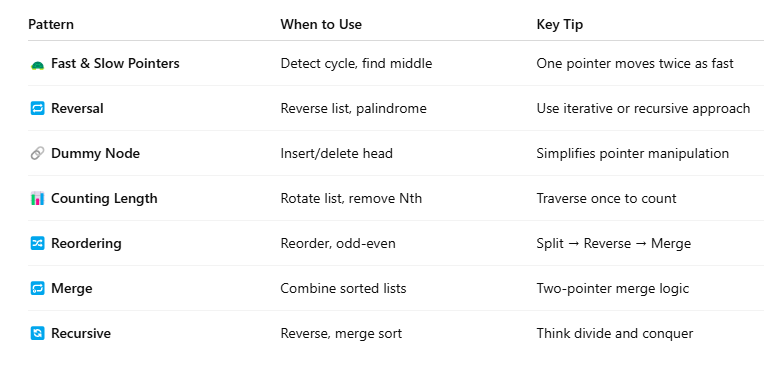
🛠️ Java Snippets for Core Patterns
✅ Reverse a Linked List
public ListNode reverseList(ListNode head) {
    ListNode prev = null;
    while (head != null) {
        ListNode next = head.next;
        head.next = prev;
        prev = head;
        head = next;
    }
    return prev;
}
✅ Detect a Cycle in a List
public boolean hasCycle(ListNode head) {
    ListNode slow = head, fast = head;
    while (fast != null && fast.next != null) {
        slow = slow.next;
        fast = fast.next.next;
        if (slow == fast) return true;
    }
    return false;
}
✅ Find the middle of a List
public ListNode findMiddle(ListNode head) {
    ListNode slow = head, fast = head;
    while (fast != null && fast.next != null) {
        slow = slow.next;
        fast = fast.next.next;
    }
    return slow;
}
✅ Reorder List (Leetcode 143)
Transform L0 → L1 → ... → Ln into L0 → Ln → L1 → Ln-1 → ...
public void reorderList(ListNode head) {
    if (head == null || head.next == null) return;

    // Step 1: Find middle
    ListNode slow = head, fast = head;
    while (fast != null && fast.next != null) {
        slow = slow.next;
        fast = fast.next.next;
    }

    // Step 2: Reverse second half
    ListNode prev = null, curr = slow.next;
    slow.next = null;
    while (curr != null) {
        ListNode next = curr.next;
        curr.next = prev;
        prev = curr;
        curr = next;
    }

    // Step 3: Merge two halves
    ListNode first = head, second = prev;
    while (second != null) {
        ListNode temp1 = first.next, temp2 = second.next;
        first.next = second;
        second.next = temp1;
        first = temp1;
        second = temp2;
    }
}
🏆 Must-Practice Linked List Questions
Here’s a set of problems that cover almost every linked list pattern:
Reverse a Linked List (Reversal)
Detect Cycle (Fast & Slow Pointers)
Find Middle Node (Fast & Slow Pointers)
Merge Two Sorted Lists (Merge)
Palindrome Linked List (Reverse + Compare)
Remove Nth Node From End (Two Pointers)
Intersection of Two Lists (Equalize Lengths)
Rotate List (Count + Connect)
Add Two Numbers (Simulate Addition)
Copy List with Random Pointer (HashMap)
Reorder List (Split + Reverse + Merge)
Odd-Even Linked List (Reordering)
✅ Tricks for Interviews
Draw diagrams: Most linked list bugs come from mismanaging pointers.
Edge cases matter: Always check for 0, 1, 2 nodes.
Dummy nodes: Use them liberally to handle head/tail changes.
Don't overcomplicate: Patterns like slow/fast pointers solve many problems.
Use print statements to debug pointer movements (or draw on paper).
🎯What You Should Practice
Reverse
Detect cycle
Find middle
Add numbers
Merge sorted lists
Reorder list
Remove nth from end
Nail these patterns, and you're in a strong position for most linked list rounds.
🚀 Final Word
Mastering linked lists isn’t about memorizing 50 problems. It’s about seeing the patterns, understanding pointer mechanics, and staying systematic under pressure.
I’ll be sharing similar breakdowns on trees, dynamic programming, and sliding window next—subscribe to stay in the loop!